A Quartz Coffee Table Can Resist Scratches Without Being Invulnerable
Yes, a quartz coffee-table top can develop scratches or other visible marks, even when its material is described as scratch resistant. That does not mean every gray line is a gouge or every dull patch needs polishing. A family-room table encounters sliding trays, game boxes, mugs, decorative bowls and the occasional hurried cleanup, so identifying what touched the surface is more useful than assuming the worst. Begin with the table’s exact material and care instructions, then distinguish a removable deposit from damage that needs assessment. With sensible handling and an appropriate response to a new mark, the table can remain an everyday gathering surface rather than a fragile object everyone avoids.
Understand the Claim Behind Scratch Resistance
Scratch resistance is a performance characteristic, not a promise that any object can be dragged across the top harmlessly. Cambria’s product-care FAQ, for example, distinguishes its quartz’s resistance from scratch-proof performance. That manufacturer statement concerns its own material; it does not establish the specification of every coffee table sold with a stone-looking top. Read the furniture maker’s information before treating a general quartz claim as a guarantee about your particular purchase.
Keep the top and the completed table separate in that assessment. A surface can resist ordinary abrasion while its edges, attachment, base or finish still require particular care. Likewise, a table may be designed for cups and books without being intended for sitting, climbing or concentrated loads. The useful expectation is durable service within the product’s stated use. Neither the word quartz nor a substantial-looking slab answers every question about how the furniture should be handled.
Confirm What the Coffee Table Is Made From
Find the order confirmation, product label or assembly booklet and look for a specific description of the top. Engineered quartz, quartzite, marble, porcelain and a decorative stone-effect finish should not be treated as interchangeable. A listing that says only stone may leave an important question unanswered. Ask the retailer to identify the material and supply the relevant care information before selecting a cleaner or arranging a repair.
If the top was fabricated separately from the base, keep both sets of records. The fabricator may identify the slab while the furniture supplier explains its mounting and movement requirements. A secondhand table can be harder to trace, so ask the seller for a brand, model or original invoice when available. An uncertain identification is a reason to seek clarification, rather than to test progressively stronger products on a visible part of the surface.
Check the documented finish as well as the material name. A polished top and a lower-sheen product may have different appearance and care considerations, even when both are marketed as quartz. Photograph the whole table and any identification label for your records. That gives the provider a clearer starting point than a close-up of a line without context, and helps establish whether advice concerns the slab, a finish or another part of the furniture.
Reconstruct the Family-Room Activity That Came Before the Mark
Think through the last use of the table without turning a possibility into a confirmed cause. Perhaps a ceramic bowl was slid aside for a board game, a tray was moved after visitors left, or a rough-bottomed object returned from another room. A new line might also have been noticed only when afternoon light changed. Record the objects involved, the direction of movement and any cleaning already attempted. This account can help the provider assess the mark while showing you which household habit deserves a closer look, whether the result proves to be residue or actual damage.
Examine the Surface Without Creating Another Test Mark
View the area under ordinary daylight and the lamps normally used beside the sofa. Notice whether the change appears as a narrow line, a broader dull patch, a raised deposit or an interruption at the edge. Take one overall photograph and a closer view from an angle that shows it. Keep the same lighting for later comparisons where practical, so a different reflection is not mistaken for an improvement or deterioration.
Avoid testing the installed top with a key, knife or another sharp object. Deliberately making a second mark will not reliably identify the first and leaves another concern to resolve. Do not scrape simply to discover whether a line has depth. The aim is to preserve the surface and useful evidence while choosing the next appropriate action, not to demonstrate how much force a table can withstand.
Start With the Exact Approved Cleaning Method
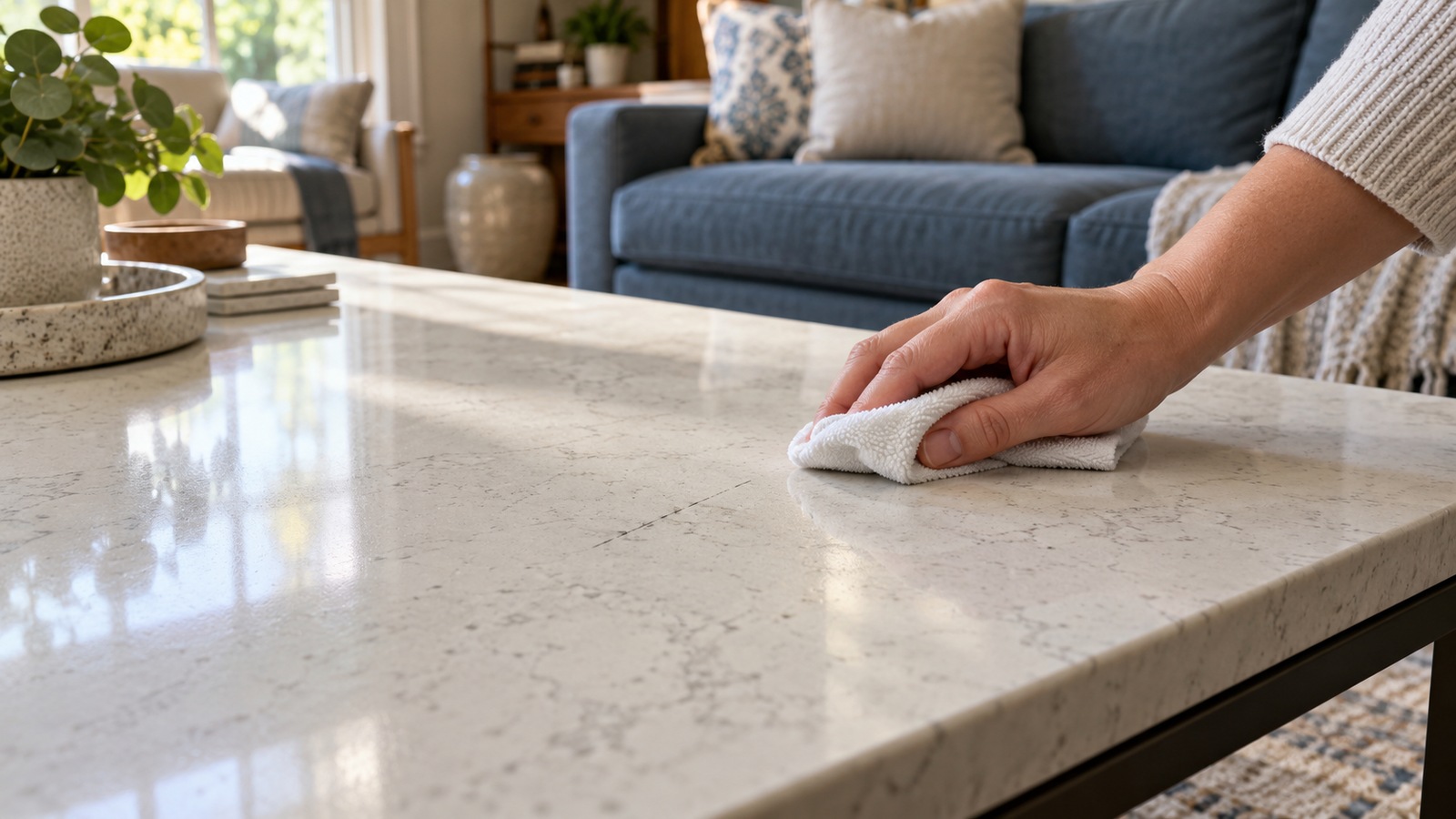
Use the routine process permitted for your product, including its stated cloth, cleaner, rinsing and drying requirements. As a material-specific example, Cambria describes warm water, a soft cotton cloth and optional mild soap for its surfaces. Confirm that those directions apply to the identified top and that the furniture maker has no additional requirements for adjoining parts. A remembered method from a previous table is not enough to establish compatibility with a new one.
Work on the affected area without flooding the base, attachment points or nearby upholstery. The tabletop, wood frame, metal finish and fabric beside it can have different care conditions. Keep cloths clean and use them as the instructions direct. A controlled routine makes it easier to tell whether the mark changes and avoids turning a small surface concern into an unrelated cleaning problem elsewhere in the family room.
Let the approved process answer only what it can. If the mark disappears, it may have been something on the surface rather than a cut requiring restoration. If it remains, record that result and stop escalating without advice. Repeated scrubbing, a stronger chemical and an improvised polishing product can alter the evidence as well as the finish. Give the provider an accurate account of the method used instead of continuing until the area looks different.
Work Through a Gray-Line Example
Suppose a narrow gray line appears where a decorative bowl was moved before game night. First identify the tabletop and photograph the bowl’s contact surface without dragging it again. Follow the permitted routine cleaning, then examine the area under the same useful light.
If the line remains, send the identification, photographs and treatment history to the supplier rather than announcing that the quartz has definitely been gouged. The provider can advise whether further approved residue removal or a damage assessment is appropriate. Until then, lift the bowl to move it and keep it off the affected area. This simple sequence addresses both the visible concern and the repeated contact without requiring the whole room to become unusable.
Treat Polishing as a Separate Decision
A dull patch is not an invitation to buff the entire top. A restoration method can change the appearance around the original concern, especially where reflected light reveals differences in sheen. Do not confuse removing something on the surface with refinishing the surface itself.
Cambria’s care document excludes abrasive pads and added topical treatments for its product. Other manufacturers’ instructions must be checked independently. An online repair technique for another surface does not override yours.
Ask an appropriate provider what the proposed treatment is expected to accomplish and which limits may remain. A professional assessment does not automatically promise an invisible repair. On a simple pale top, a small reflection change can be noticeable from the sofa even if it appears minor in a photograph. Understanding that possibility before authorizing work is more useful than assuming every mark can be removed completely through household polishing.
Make Everyday Contact Easier on the Table
Lift movable accessories instead of repeatedly sliding them. Give a serving tray, bowl or game box enough room to be handled comfortably, particularly when several people are reaching across the same surface. Examine contact faces when an object returns from storage or another room. Loose debris beneath an accessory is worth removing through an appropriate method before the item goes back, rather than relying on the top’s resistance to make its condition irrelevant.
Arrange the table around its real tasks. If a display fills most of the surface, guests may push it aside each time someone brings a cup or starts a game. Reduce that display or give it another suitable place so care follows naturally from using the room. Keep hands-on projects suited to their equipment and handling requirements too; a quartz label does not make the coffee table appropriate for every craft. Use a suitable setup elsewhere when needed, leaving this surface ready for the family-room activities it can support comfortably.
Choose Accessories by Compatibility Rather Than Their Name
A coaster, tray or protective pad is useful only when its contact material and care suit the actual table. Check the accessory and furniture guidance rather than assuming anything labeled protective is harmless indefinitely. Keep the contact face maintained and lift it for appropriate routine care. Avoid adhesive additions or a permanent cover unless the supplier permits them. Protection should make cups and shared activities simpler without concealing the top so completely that spills, deposits or a developing issue remain unnoticed.
Separate Scratches From Other Kinds of Damage
An edge chip, a loose top and a change in the base are different concerns from a line across the surface. Describe where the problem occurs and whether anything has shifted. A damaged or insecure table needs the relevant provider’s guidance before ordinary use continues. Do not attempt to stabilize a questionable attachment with improvised packing or treat an exposed chip with a routine cleaning method.
Heat and chemical limits also remain separate from scratch resistance. Follow the top’s instructions for hot items and permitted products, including anything brought into the family room for refreshments or a hobby. A hard surface is not automatically heat-proof or chemical-proof. Keep unsuitable supplies away from the regular table-cleaning kit so a stronger household product is not chosen casually when someone notices a stubborn mark.
Prepare a Useful Service Request
Give the retailer or fabricator the table model, top identification, purchase date and clear photographs. Explain the ordinary activity before the mark appeared and list every treatment already attempted. Be precise about uncertainty: the bowl was moved, the line appeared in that area, and approved cleaning did not remove it. This is more useful than insisting on a cause that has not been established.
Ask who handles the next assessment and whether the applicable warranty covers the reported issue. Furniture and slab coverage may be separate, and damage is not automatically a manufacturing defect. Keep the written response with the original care information. A defined service route prevents several people from offering conflicting suggestions without anyone taking responsibility for the actual product.
Once a response is agreed, follow that sequence rather than combining it with unrelated remedies. Ask whether the table can remain in ordinary use while awaiting service and what should happen to accessories near the area. If an assessed repair has limits, weigh those against the table’s continuing usefulness. Replacing the entire piece is not necessarily the first answer to a cosmetic concern that can be understood and managed.
Decide What the Mark Changes About Ownership
A resolved mark can lead to a small, specific improvement: a less crowded display, lifting the tray, an approved care cloth kept nearby or clearer instructions for shared cleanup. It need not turn every cup into a source of worry. If you are choosing a new quartz coffee table, ask about the identified top, finish, approved care and local service before purchase. Then consider those answers alongside its usable size, base and fit with the sofa. Realistic confidence comes from knowing the furniture’s capabilities and limits, with an everyday routine that lets the family room keep functioning comfortably.