Ask How a Floor Can Fail Before Asking Which Is Strongest
The most durable flooring for a busy home depends on which demands the floor must handle and what you expect after years of use. Surface wear, scratches, dents, moisture exposure, and repairability are different questions. A material that performs well against one may still have limits in another. Compare those questions separately, then match the answers to your household. This approach makes a flooring shortlist more useful than a single ranking that ignores installation and care. It also helps you recognize when a repairable surface with manageable marks may serve your home better than a surface chosen mainly for an impressive durability claim.
Build a Brief With Five Distinct Failure Modes
Start with five columns: repeated surface wear, scratches from localized contact, dents or chips from force, moisture exposure, and repair after damage. A busy corridor’s grit belongs in a different column from a dining chair’s small contact area. A child’s dropped metal toy differs again from water left beside the door. List events that actually occur before worrying about unlikely disasters. This brief gives a supplier something specific to answer and prevents one attractive test result from being used to settle every kind of durability.
Also describe the visible aging you can accept and the service disruption you can tolerate. Someone who enjoys wood’s changing appearance may accept marks that would disappoint an owner seeking a uniform polished floor. A family unable to clear the entire room for refinishing may prefer a documented local replacement route, provided that spare material and access are realistic. Put a planned desk or dining-area move in the brief too, because it changes concentrated contact. These practical limits help choose between competing strengths rather than chasing a floor that supposedly has none of the weaknesses.
Compare Resistance and Repair in Different Columns
For repeated dry wear, a documented laminate abrasion classification gives useful evidence about its protected face; it does not establish water performance. For wet cleanup, suitable porcelain tile offers a hard face, while its grout, traction, support, and potential edge damage remain separate issues. Vinyl deserves consideration when underfoot give and an approved moisture arrangement matter, but its furniture-protection instructions should be read for indentation limits. Wood brings a distinctive repair question: a finish or construction with an available renewal route may justify accepting ordinary marks. No category name proves that a particular installation can be sanded or repaired in the way you expect. Compare the named product’s answer in each column rather than awarding a single strongest-material prize.
Consider Porcelain and Ceramic as Installed Systems
Tile can be a strong candidate where an appropriate product and installation suit the location. Review whether the chosen tile is intended for the proposed floor use, and ask how its surface performance is described. Daltile’s selection guidance identifies performance factors that deserve attention beyond appearance. Use those factors to discuss the actual product rather than assuming every tile with the same printed look performs identically.
The supporting assembly matters. Preparation, suitable installation materials, movement details, and fitting conditions belong in the durability plan because the visible tile face is only one component. Have the installer explain what the existing floor requires before tile is installed. A hard sample does not demonstrate whether the substrate or completed installation is appropriate. Treat installation cost as part of the material’s practical performance rather than an inconvenient extra to omit from comparison.
Evaluate Vinyl Beyond Its Printed Surface
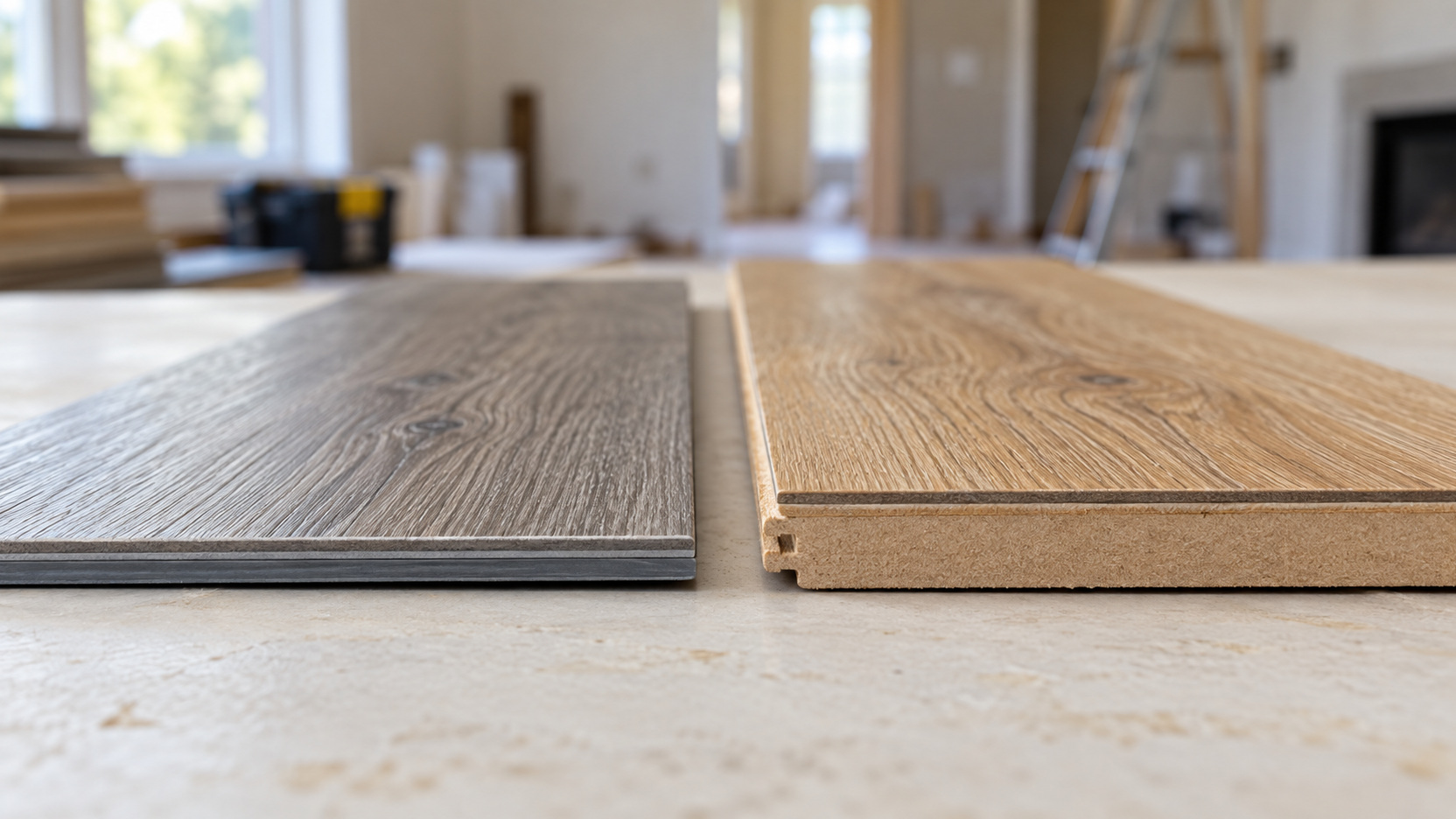
Luxury vinyl flooring contains products with different constructions, surface layers, finishes, and fitting methods. Request the documentation for the exact model and ask how it handles the demands you listed. A wear-layer figure can be relevant without answering every concern about concentrated loads, movement, or localized damage. Compare products using their complete information rather than assuming that a single number predicts your entire ownership experience.
Pay particular attention to furniture and appliance contact. Follow the floor maker’s directions for suitable protection and movement instead of expecting a new surface to absorb every repeated action. Ask whether the planned installation is suitable for the room’s fixed furnishings and conditions. An attractive resilient plank can be a practical choice, but its documented use and installation requirements still need to match the way the home operates.
Discuss repairs in terms of the installation method. Replacing a localized area may involve more than having a spare plank, and access can differ across systems. Request a realistic explanation of what would happen if one section were damaged after the room is furnished. Keep product identification and matching material as recommended, while understanding that repair outcomes depend on the actual problem and assembly. This adds a useful service dimension to the initial surface-performance comparison.
Compare Laminate Using Defined Product Claims
Laminate is another broad category whose individual products deserve separate evaluation. Review surface-performance information, location permissions, and the conditions attached to water-related claims. The Pergo FAQ provides examples of why product use and fitting conditions matter. Obtain the guide for the exact collection and model proposed for your home. A benefit advertised for one product should not become a promise about every laminate floor or every room where someone might want to install it.
When a salesperson mentions a rating, ask what is measured and how it helps address your household events. A defined rating can support an informed comparison while leaving other concerns unresolved. Include edge detail, fitting requirements, furniture contact, and the approved care routine in the discussion. You should leave with a clear explanation of the product’s relevant strengths and limits rather than only a memorable score.
Judge Wood by Finish, Construction, and Renewal
Wood flooring needs more detailed discussion than a simple hard-versus-soft material ranking. Construction, finish, and the possibility of later service all affect ownership. Ask what routine care is appropriate and whether the precise product can be renewed or repaired professionally under relevant conditions. Do not assume every engineered or solid wood floor has the same future options because both are described as wood. The prospect of renewal can be valuable, but it needs an honest explanation tied to the floor you are buying, its condition, and the available local service rather than an unlimited promise of repeated refinishing.
Put Moisture in Its Own Column
Water-related performance should be reviewed separately from traffic and surface damage. Product claims may define particular conditions, installation steps, or limits that are important to the room. Ask what applies at edges, transitions, and the completed assembly, and how you should respond to ordinary spills. A material’s face-layer description does not automatically explain everything that can happen below or beside it.
Room suitability must come before convenience. Discuss the actual location with the supplier and installer, including any conditions that may rule out a candidate. Keep those answers in the project record so they are not forgotten when appearance and price become the focus. A product with excellent surface performance is still the wrong proposal if its permitted use does not match the intended room.
In daily care, follow the relevant moisture guidance instead of assuming harder-looking means more tolerant of wet cleaning. The National Wood Flooring Association advises against wet and steam mopping wood flooring. Other surfaces should follow their own product instructions rather than inheriting a method from the previous floor. Durability is supported by compatible habits, and that responsibility belongs in the buying decision rather than emerging only after an avoidable care problem.
Include Soft Flooring in the Service Discussion
Carpet can remain appropriate when comfort and the room’s use support the choice, but its durability brief differs from that of a hard surface. Discuss the selected product’s use suitability, appearance expectations, and routine maintenance. Concentrated traffic patterns can affect how the room looks even when the remainder stays lightly used. The Carpet and Rug Institute’s maintenance guidance helps place suitable cleaning and vacuuming within ownership. Ask about the care and warranty conditions attached to the exact product instead of judging it from pile feel alone. Comfort is a real benefit when accompanied by a realistic maintenance plan.
Choose a Finish You Can Live With Between Services
The visibility of wear can influence satisfaction almost as much as the underlying performance. A very uniform dark finish may reveal contrasting dust and marks, while a varied pattern can alter what you notice. Neither appearance proves that damage has been prevented. View samples under actual daylight and evening light, and consider the angles from which you see the main floor areas.
Texture also has practical implications. Strong surface relief can change the feel and appearance while requiring an appropriate method to remove fine debris. Ask how the proposed finish is maintained and whether you are comfortable with the routine. A finish chosen for its forgiving appearance should still support the care process the household is willing to repeat. Durability becomes useful when the floor remains both functional and acceptable in ordinary daily view.
Compare Repair Paths Before the Final Price
Ask how each shortlisted floor would be assessed after a localized problem. The relevant answer may involve professional repair, replacement of a defined area, or work across a larger section. Learn whether matching material is available now and what records or spare pieces should be retained. A repair strategy can add value even when it requires professional work, provided the expected limits are clear.
Consider disruption as well as the invoice. Some service processes require access to a substantial area, moving furnishings, or time away from normal use. Ask the appropriate provider to explain what is likely for the product being proposed without promising a universal timeline. This gives you a more complete ownership comparison than treating repairability as a yes-or-no feature detached from the furnished home.
Then compare complete installed quotes with equivalent scopes. Preparation, transitions, fitting, protection details, and necessary related work belong beside material cost. A less expensive sample can be a sensible choice, but an incomplete proposal makes the price misleading. Request written identification of the product and installation so the performance information, warranty, and care directions all refer to the same finished floor.
Select the Best Match Across the Failure Modes
Apply the columns to a dining room and a mudroom separately. In the dining room, chair contact and the appearance of small marks may drive the choice; a serviceable wood finish or documented hard-face product can fit, with different protection routines. In the mudroom, wet grit and reachable cleanup can make suitable tile a stronger starting point, accepting its hard feel and joint work. A suitable resilient proposal might instead win where comfort is decisive and its installation answers the moisture brief. Write the remaining weakness beside the winning benefit so the decision stays honest. Choosing through an explicit tradeoff is more useful than calling the same material best for both rooms.
Keep the documents and service contacts that make the choice understandable later. A durable floor is a suitable product within a sound installation, maintained in ways that fit its instructions and the home’s habits. It can still show ordinary working life without having failed the buying brief. By comparing the ways a floor can be worn, marked, affected by moisture, and repaired, you give yourself a more useful decision than the broad promise of the strongest floor imaginable.